
1. Morphological Architecture & Preservation
Sanskrit is recognized by computational linguists as the definitive benchmark of an inflectional language because it preserves almost the entire, highly complex morphological system of Proto-Indo-European.
While languages such as English, Spanish, and even Latin progressively simplified their structural morphology over millennia, Sanskrit locked its exceptionally rich inflectional framework into place through the formal, axiomatic grammatical rules of Pāṇini’s Aṣṭādhyāyī (circa 4th century BCE).
Sanskrit represents the pinnacle of inflectional synthesis across four structural pillars:
2. The 24-Form Noun Matrix (Declension)
In non-inflected or minimally inflected languages:
- English: A noun typically has only two surface forms (e.g., boy, boys), relying on word order and auxiliary prepositions to denote syntactic function.
- Latin: A noun possesses approximately 10 to 12 distinct forms across 5 or 6 cases.
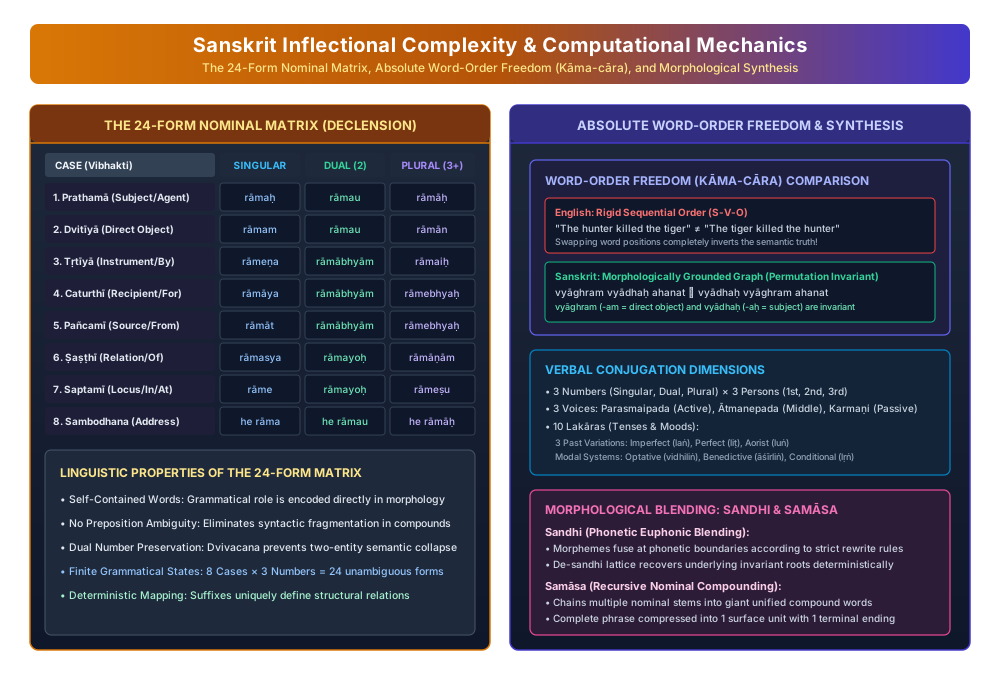
Sanskrit expands this into a full 24-cell inflectional matrix per nominal stem, systematically distinguishing 8 grammatical cases across 3 distinct grammatical numbers:
| Case (*Vibhakti*) | Syntactic Function | Singular (*Eka*) | Dual (*Dvi*) | Plural (*Bahu*) |
|---|---|---|---|---|
| 1. Prathamā | Nominative (Subject / Agent) | rāmaḥ | rāmau | rāmāḥ |
| 2. Dvitīyā | Accusative (Direct Object) | rāmam | rāmau | rāmān |
| 3. Tṛtīyā | Instrumental (Means / With) | rāmeṇa | rāmābhyām | rāmaiḥ |
| 4. Caturthī | Dative (Recipient / For) | rāmāya | rāmābhyām | rāmebhyaḥ |
| 5. Pañcamī | Ablative (Source / From) | rāmāt | rāmābhyām | rāmebhyaḥ |
| 6. Ṣaṣṭhī | Genitive (Possession / Of) | rāmasya | rāmayoḥ | rāmāṇām |
| 7. Saptamī | Locative (Locus / In, At, On) | rāme | rāmayoḥ | rāmeṣu |
| 8. Sambodhana | Vocative (Direct Address) | he rāma | he rāmau | he rāmāḥ |
Multiplying 8 cases × 3 numbers yields up to 24 distinct inflected forms for a single noun, encoding semantic role, number, and case directly onto the word surface.
3. Absolute Word-Order Freedom (*Kāma-cāra*)
Because every noun, adjective, and pronoun is fully inflected to declare its exact syntactic function, word order in Sanskrit is completely flexible (*Kāma-cāra*).
-
In English, word order dictates semantics:
"The tiger killed the hunter" means the exact opposite of "The hunter killed the tiger". -
In Sanskrit, word order can be scrambled into any permutation without altering the underlying meaning or causal relationships:
The inflected case endings (*vibhakti*) unambiguously identify the agent (*kartā*) versus the patient (*karma*). - This property makes sentence parsing a graph matching and constraint satisfaction problem over kāraka dependencies, rather than sequential linear token prediction.

4. Hyper-Specific Verbal Conjugation
A single Sanskrit verbal root (*dhātu*) inflects across multiple orthogonal grammatical axes:
Singular (*Ekavacana*), Dual (*Dvivacana*), and Plural (*Bahuvacana*).
First (*Uttama* = English 1st), Second (*Madhyama* = English 2nd), Third (*Prathama* = English 3rd).
Active (*Parasmaipada*), Middle/Reflexive (*Ātmanepada*), and Passive (*Karmaṇi*).
Multiple past tenses (imperfect *laṅ*, perfect *liṭ*, aorist *luṅ*), conditional moods (*lṛṅ*), and optative/benedictive forms.
5. Morphological Synthesis: Sandhi & Samāsa
What elevates Sanskrit beyond conventional inflectional systems is the mathematical interaction among inflections:
A. Phonetic Blending (*Sandhi*)
When morphemes or words occur contiguously, their adjoining phonetic boundaries transform and fuse according to strict euphonic rewrite rules. The resulting surface string coalesces, while the underlying morphological identities remain deterministically recoverable through systematic de-sandhi analysis.
B. Recursive Nominal Compounding (*Samāsa*)
Sanskrit can chain multiple nominal stems and modifiers together into single, unified compound words. Rather than generating a descriptive phrase (e.g., "the sovereign who possesses a vast brigade of armored elephants"), Sanskrit compresses the entire semantic relationship into a single multi-constituent compound word that receives its singular inflectional termination at the end of the compound.
