Pāṇini’s 4th-century BCE formal grammar is widely recognized by computer scientists as the earliest ancestor of formal language theory and Backus-Naur Form (BNF). This glossary maps traditional linguistic terms to modern programming, data structures, and computational concepts so students, investors, and engineers speak the same language.
Pāṇini’s monumental treatise consisting of ~4,000 algorithmic rules (*sūtras*) organized into eight chapters. Rather than simply describing existing sentences, it acts as a deterministic generative compiler: you feed in a conceptual root (*dhātu*) and intent tags (*pratyayas*), and the engine executes transformation rules to compile the exact, grammatically valid output string.
Why it matters: Unlike modern statistical LLMs that "guess" the next word probabilistically, the Aṣṭādhyāyī guarantees zero hallucinations through exact rule-based compilation.
compiler.compile(root=DHATU, intent=TENSE_PERSON) -> ValidString
The indivisible verbal root or semantic primitive. In Sanskrit, nearly every noun, adjective, and verb is derived from approximately 2,000 atomic verbal roots (*dhātus*). A *dhātu* carries the pure seed action (e.g., गम् gam = "to go", भू bhū = "to become").
Why it matters: Instead of storing millions of isolated vocabulary tokens in an embedding matrix, an Indic engine only needs to track core roots and their mathematical derivation formulas.
class Dhatu_Gam(PrimitiveAction): # "to go"
  def instantiate(self, *modifiers): ...
An affix or suffix appended to a root (*dhātu*) or nominal stem (*prātipadika*) to specify tense, aspect, mood, person, case, or part of speech. When a *pratyaya* attaches to a root, it triggers specific phonetic and morphological transformation rules to produce a finalized word (*pada*).
Why it matters: Pratyayas act like typed parameters that modify the state of a base class deterministically.
@decorate(tense=Present, number=Singular, person=Third)
def gam(): return "gacchati" # (He goes)
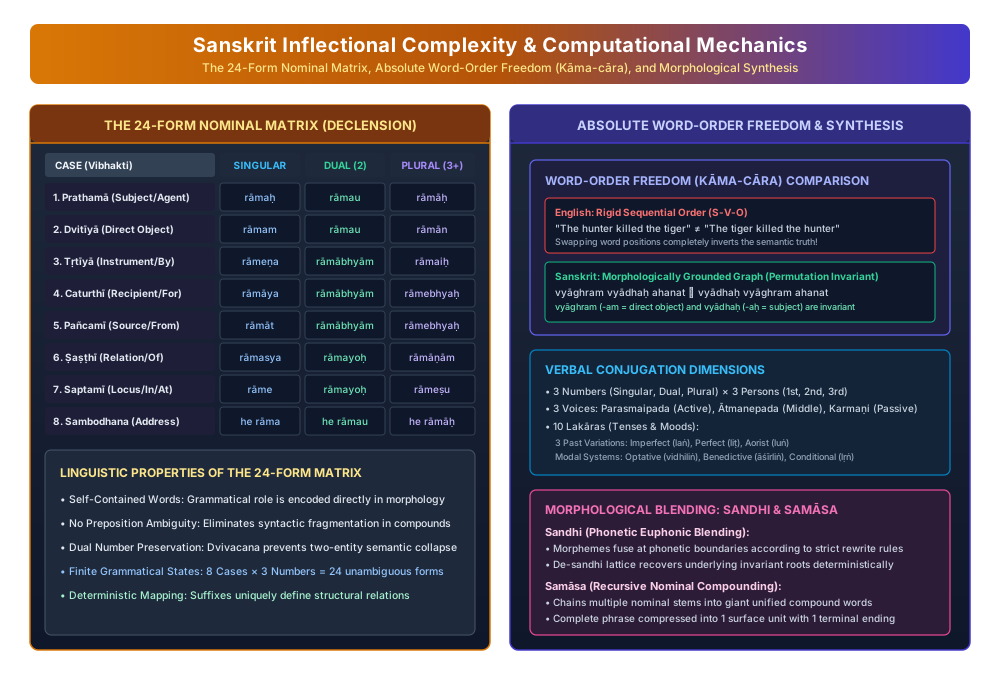
Inflectional case endings applied to nouns. Sanskrit features a 24-form nominal matrix: 8 grammatical cases (Nominative, Accusative, Instrumental, Dative, Ablative, Genitive, Locative, Vocative) multiplied by 3 grammatical numbers (Singular, Dual, Plural). Every noun carries an explicit ending that announces its exact grammatical role in the sentence.
Why it matters: In English, if you change word order from "Dog bites man" to "Man bites dog", the meaning flips completely. In Sanskrit, because words carry their own *Vibhakti* badges, word order has zero impact on grammatical validity or semantic roles.
execute_action(
  agent="hunter_1", # 1st Case (Prathamā)
  target="tiger_1", # 2nd Case (Dvitīyā)
  instrument="bow" # 3rd Case (Tṛtīyā)
)
The deep syntactic-semantic relationship between nominal items and the central action (*kriyā*). Pāṇini defined six fundamental kārakas: Kartā (Agent / Source of independent action), Karma (Direct Object / Goal), Karaṇa (Instrument / Means), Sampradāna (Recipient / Beneficiary), Apādāna (Point of Origin / Separation), and Adhikaraṇa (Locus / Space-Time Context).
Why it matters: Kāraka theory directly maps human thought to modern Directed Acyclic Knowledge Graphs (DAGs) without ambiguous parsing.
Graph.add_edge(source=Agent, target=Action, label="Kartā")
Graph.add_edge(source=Action, target=Object, label="Karma")
Absolute syntactic freedom of word order. Because every Sanskrit word is self-encapsulated with its case, gender, number, and syntactic role, tokens in a sentence can be placed in any sequence without altering the logical core meaning.
Why it matters: Positional embedding vectors in Transformer models (e.g. RoPE) are often brittle when word order changes. Understanding Sanskrit's order invariance allows building robust, topology-based reasoning models.
# Any order evaluates to the same state:
{"agent": Rama, "action": sees, "object": forest} ==
{"action": sees, "object": forest, "agent": Rama}
Deterministic phonetic blending across word and morpheme boundaries. When two phonetic units occur adjacent to each other, their vocal tract interaction causes them to fuse into a harmonious sound according to strict mathematical rules (e.g., deva + ālaya = devālaya; tat + ca = tacca).
Why it matters: Standard AI models frequently misparse blended Sandhi words as brand new unknown tokens. An Aindrak-powered parser splits and resolves Sandhi with 100% mathematical reversibility.
fuse_stream(tokenA.last_phoneme, tokenB.first_phoneme) -> fused_phoneme
Morphological compounding. Multiple nouns and adjectives are combined into a single, cohesive compound word with intermediate case markers dropped, receiving a single inflectional ending at the very end. Categories include Tatpuruṣa (deterministic dependency), Bahuvrīhi (external reference / pointer), and Dvandva (parallel sets).
Why it matters: Rather than using multi-word clauses that consume tokens, Sanskrit compresses complex hierarchical relationships into a single memory-efficient struct.
struct CompoundConcept {
  Entity modifier;
  Entity head;
};
Fourteen compact phonetic formulas that organize all sounds of the language by acoustic properties (vowels, semivowels, nasals, sibilants, voiced stops, unvoiced stops). By combining the start character of a subset with a terminator marker (*it*), Pāṇini created Pratyāhāras — concise abbreviations for complex sound intervals.
Why it matters: A single two-letter code like अच् (ac) matches all vowels, and हल् (hal) matches all consonants — functioning as a concise regex range or character class filter.
const auto PRATYAHARA_AC  = "[aeiouāīūṛṝḷ]"; // All vowels
const auto PRATYAHARA_HAL = "[k-h]";         // All consonants
The foundational rule-priority conflict resolution mechanism in Pāṇinian grammar. An Utsarga is a general, default rule that applies broadly. An Apavāda is an exception rule designed for a specialized, narrower context. In the Pāṇinian engine, a specific exception rule unconditionally overrides the generic rule (*Apavādo hy utsargaṁ bādhate*).
Why it matters: Eliminates runtime conflicts deterministically, ensuring unambiguous rule execution across the entire morphological system.
if (has_specialized_override(context)):
  execute_apavada_rule()
else:
  execute_default_utsarga_rule()